Carbon Leakage under CBAM and Free Allocation
Author(s): Andrei Marcu, Alexandra Maratou, Francesca Calvo
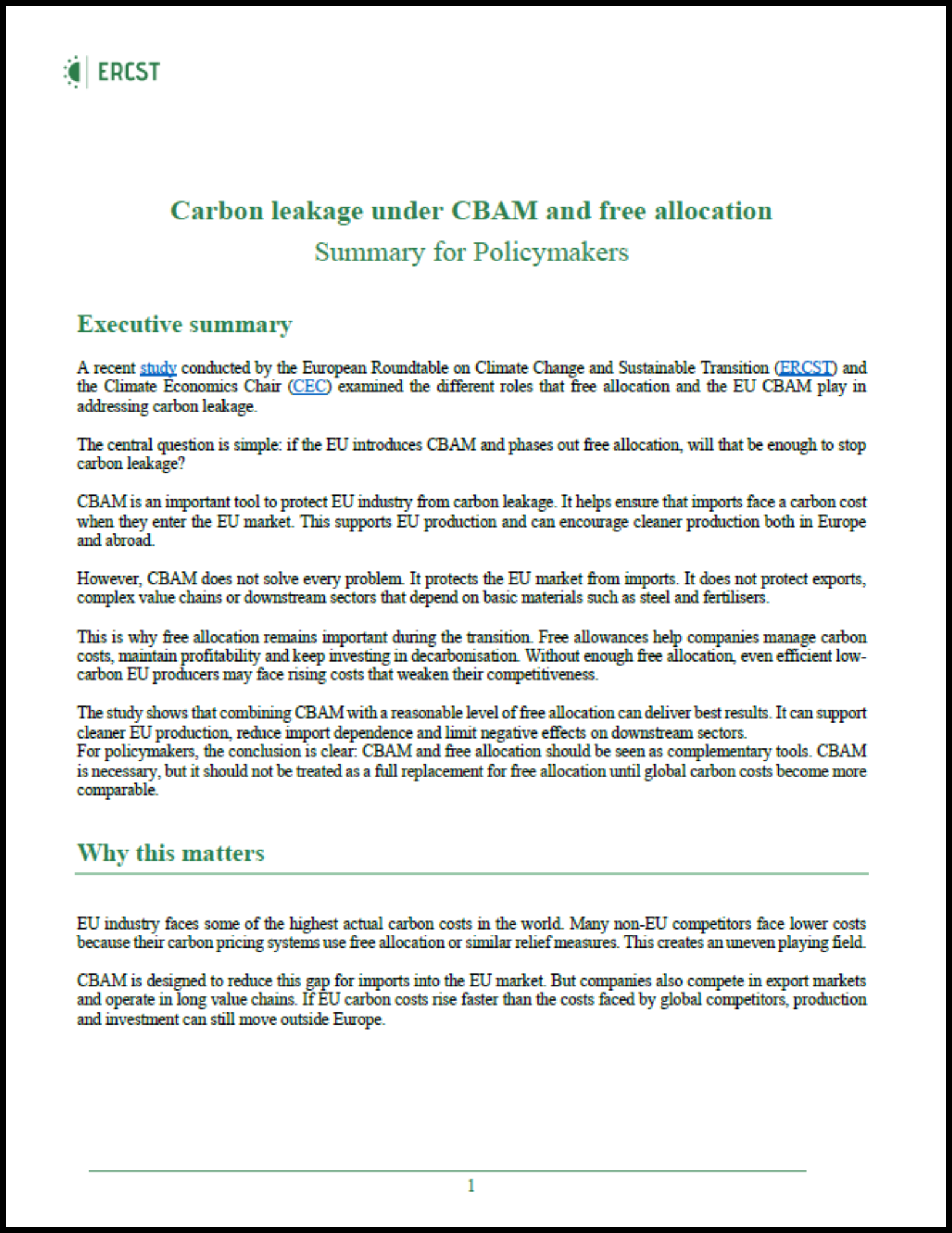
A recent study conducted by the European Roundtable on Climate Change and Sustainable Transition (ERCST) and the Climate Economics Chair (CEC) examined the different roles that free allocation and the EU CBAM play in addressing carbon leakage.
The central question is simple: if the EU introduces CBAM and phases out free allocation, will that be enough to stop carbon leakage?
CBAM is an important tool to protect EU industry from carbon leakage. It helps ensure that imports face a carbon cost when they enter the EU market. This supports EU production and can encourage cleaner production both in Europe and abroad.
However, CBAM does not solve every problem. It protects the EU market from imports. It does not protect exports, complex value chains or downstream sectors that depend on basic materials such as steel and fertilisers.
This is why free allocation remains important during the transition. Free allowances help companies manage carbon costs, maintain profitability and keep investing in decarbonisation. Without enough free allocation, even efficient low-carbon EU producers may face rising costs that weaken their competitiveness.
The study shows that combining CBAM with a reasonable level of free allocation can deliver best results. It can support cleaner EU production, reduce import dependence and limit negative effects on downstream sectors.
For policymakers, the conclusion is clear: CBAM and free allocation should be seen as complementary tools. CBAM is necessary, but it should not be treated as a full replacement for free allocation until global carbon costs become more comparable.