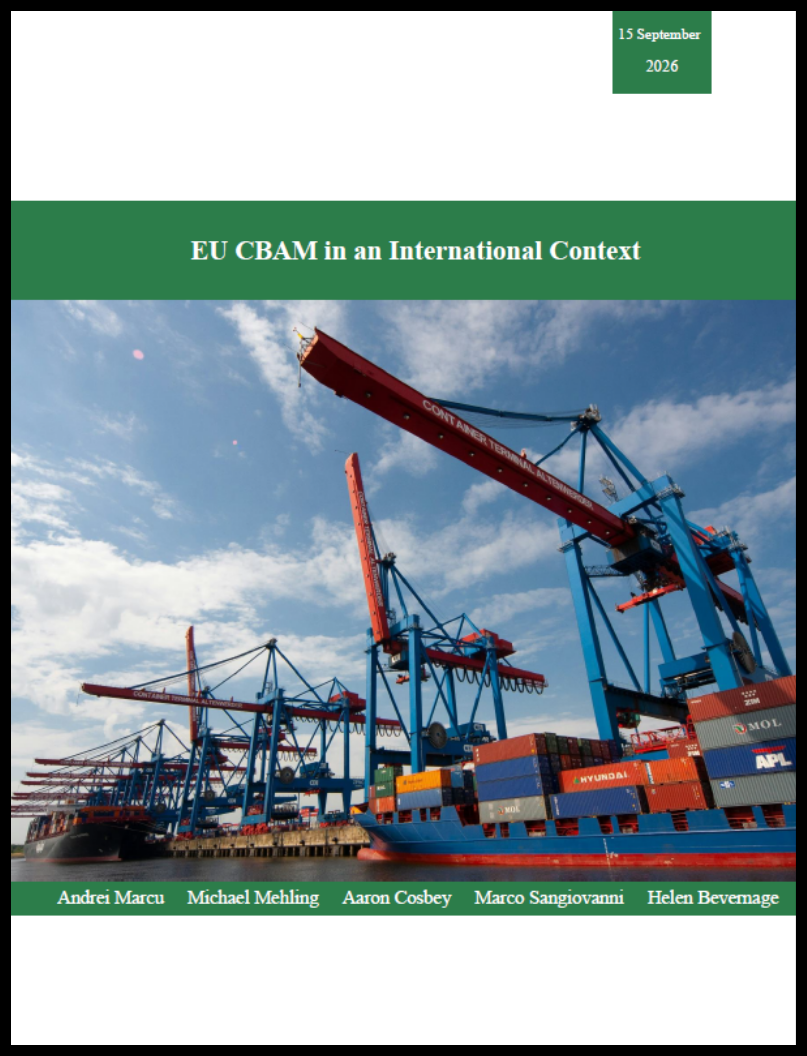
Discover our latest publication: ERCST’s paper on EU CBAM in an International Context, which discusses how the mechanism interacts with third-country carbon pricing systems, trading partner responses, and prospects for international cooperation .
Key ERCST observations:
- The EU framework contains the tools needed to engage with third countries: recognition of carbon prices under Article 9, bilateral agreements under Article 2(12), and a verification and accreditation architecture, but each is constrained in practice in ways that limit what it delivers.
- The CBAM has accelerated carbon pricing adoption among major trading partners, with Brazil, Türkiye, China, India, Indonesia, and Vietnam all advancing carbon market frameworks on timelines that track CBAM phase-in. This is a spillover effect that may prove more significant than the mechanism’s direct leakage prevention.
- International resistance is growing and coordinating: developing countries secured a first reference to unilateral trade measures in COP30 decision text, while Russia’s WTO challenge is advancing towards panel establishment.
- The proliferation of border carbon adjustment proposals (p.e. UK, Taiwan, Norway, and others) risks creating a fragmented “spaghetti bowl” of divergent MRV requirements, multiplying compliance costs for exporters without advancing decarbonization.
- No single body currently leads on MRV interoperability, despite high interest from the Climate Club, IFCMA, TESSD, IFCCT, and the new ISO-GHG Protocol collaboration.
- The EU should pair its leverage with support. This means dedicating a share of CBAM revenues to industrial decarbonization and compliance assistance in developing countries, and engaging substantively in the IFCCT and UNFCCC trade dialogues rather than treating them as threats to be managed.